

Bloom’s Taxonomy was created in 1956, by educational psychologist Dr. Benjamin Bloom, and subsequently updated in 2001 to its current form. It is based on hierarchical ordering of learner’s cognitive skills, which then facilitates learning professionals (L&D) and Instructional Designers (ID) in helping learners learn better. To help instructors and course developers understand how to achieve their learning objectives, the taxonomy breaks down human thinking skills into six categories, ascending as a pyramid from lower to higher-orders of thinking. Using Bloom's Taxonomy Understanding Bloom’s Taxonomy can play a vital role in helping eLearning professionals create highly effective learning objectives; organize learning into logical structures to help make learning a seamless process; inject focused interactivity into courses; and design course assessments that truly evaluate whether learners have mastered desired learning objectives. Here are some strategies and tips to help … [Read more...] about Blooms Taxonomy: Tried and tested recipe for effective eLearning
The ELearning Course Designer’s Blog
Why You Should Never Skip the Needs Analysis Phase

It seems that, as the demand for eLearning continues to grow, the need for conducting Training Needs Analysis (TNA) continues to take a back seat through the course development process. To be fair, most Instructional Systems Design (ISD) professionals understand very well what needs analysis is all about. Yet, somehow, circumstances often compel many to ignore this very important step. News Flash: Skipping TNA is a bad idea! We’ll take a closer look at why that’s so; and we’ll also review some strategies to help stakeholders in eLearning projects – sponsors, SMEs, clients, supervisors understand why TNA is a very important phase. THE IMPORTANCE OF TNA An eLearning course designed without a TNA is like planning a trip without a destination in mind. How will you know when you’ve arrived? And needs analysis isn’t unique to eLearning. Project proponents must ground a project, regardless of size, budget or duration, around a need for it. Otherwise, once completed, how are stakeholders … [Read more...] about Why You Should Never Skip the Needs Analysis Phase
Working with SMEs for Better Instructional Design Outcomes: How to produce win-win relationships and reduce stress on a project

Let’s face it – we, as Instructional Designers, aren’t masters of all aspects of course design and development. It takes a team to put together a successful course, and it takes aligning ourselves with Subject Matter Experts (SMEs) to make success happen. However, because of the differing perspectives they bring to the instructional design team, working with SMEs can sometimes be challenging. But it needn’t be. In this article, I'll tell you how you can forge win-win relationships with your SME partners, and explain some tips and tools to use in order to make success happen. What SMEs Bring to the Team Before understanding how to build exceptionally productive relationships with SMEs, it may be prudent to take a step back to understand who SMEs are, and how they add value to a course design and development project. It may sound redundant, but it’s worth repeating: SMEs are not instructional design specialists – that’s the role of IDs. However, subject matter expertise – be it in … [Read more...] about Working with SMEs for Better Instructional Design Outcomes: How to produce win-win relationships and reduce stress on a project
Gagne’s Nine Events of Instruction: How to create eLearning experiences that will blow your learners’ minds
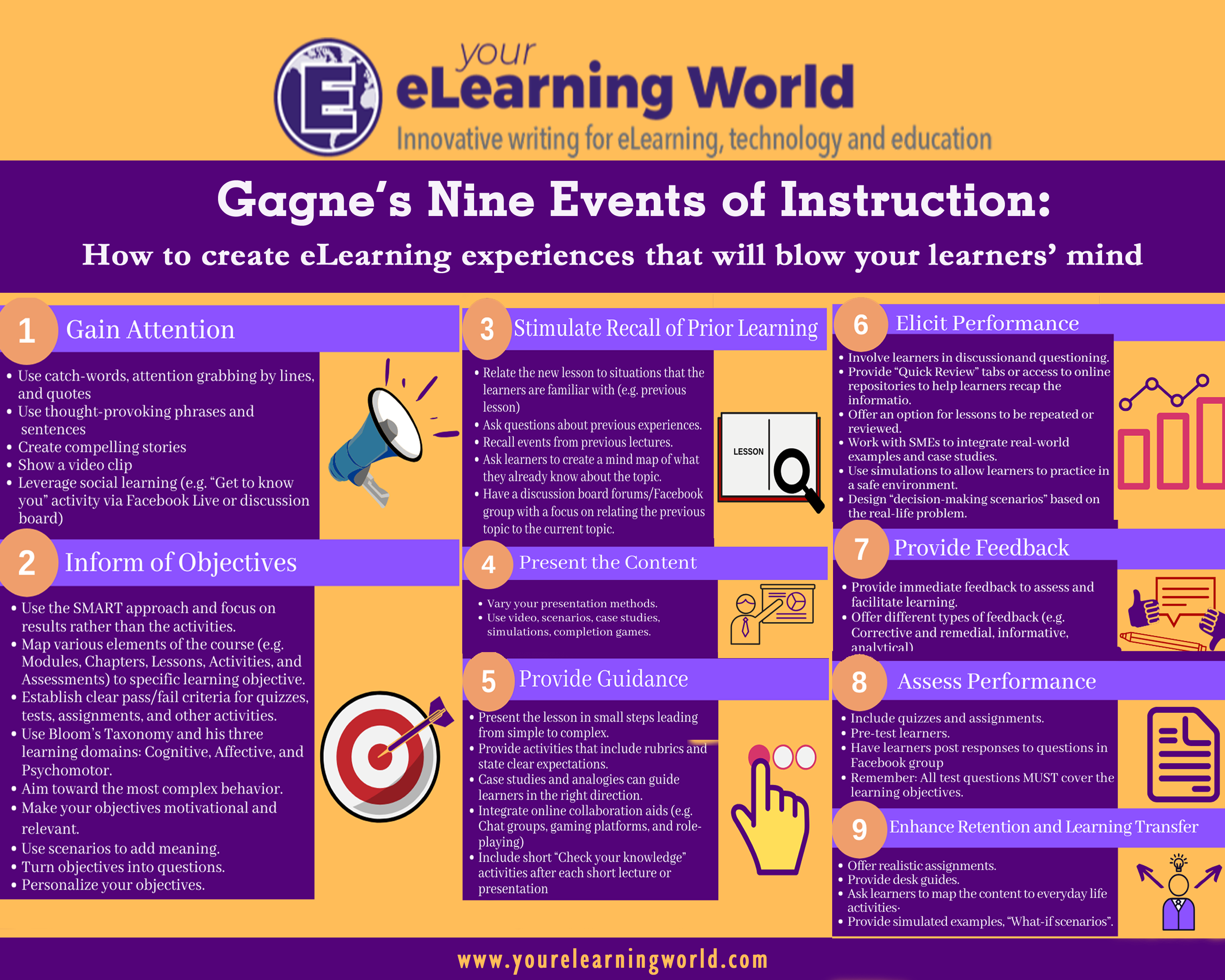
If you are an instructional designer, you've probably heard of Robert Gagne. Gagne was an American educational psychologist best known for his Conditions of Learning. Gagne believed that there are several different levels of learning, and each level requires different types of instruction. He created a nine-step process that detailed each element required for effective learning: The Nine-steps are: Gain attention Inform learners of objectives Stimulate recall of prior learning Present the content Provide “learning guidance” Elicit performance (practice) Provide feedback Assess performance Enhance retention and transfer to the job Gagne's Nine Levels of Learning model provides a checklist that ensures that you present comprehensive and successful learning experience. His approach also motivates learners and helps them associate the topics covered in your course with their previous knowledge. Another benefit of … [Read more...] about Gagne’s Nine Events of Instruction: How to create eLearning experiences that will blow your learners’ minds
Agile ELearning Development: Making the best of user stories

At the center of every agile eLearning development project are the User Stories that underpin that initiative. Juxtapose those stories to the countless amounts of documents that you would create to describe the solution using other methodologies – like ADDIE. That’s not to say that User Stories completely replace all the requirements and design specifications. However, they (User Stories) give solution designers and developers a unique view of the solution from a users’ perspective. How to Frame User Stories Think of User Stories as individual features and functionality traits that users would like to see the solution deliver. These traits will differ/depend upon: The role <Type of User> the user plays when interacting with the solution The outcome <goals or objective> they are trying to produce in that role The value proposition <reason or benefit> they expect from accomplishing those goals Typically, here’s how you would frame a User Story: In … [Read more...] about Agile ELearning Development: Making the best of user stories
Agile ELearning Development: Secrets of Agile meetings success

Meetings are an integral part of any corporate process, including developing eLearning content and courses. BUT…there’s a catch to meetings: They can be taxing on participants (mentally, physically and emotionally), and can be a drain on valuable resources. But there’s good news too: As an eLearning development professional, you can make meetings productive and yet not spend as much time as you currently do. Read on to learn how! The facts about meetings According to research cited by the Harvard Business Review, over the past 5-decades, the number of hours a week spent in meetings has increased by over 130%. Despite technological innovations that cut-down travel, improve communication and enhance collaboration, corporate America spends nearly 23-hours a week in meetings versus less than 10-hours back in the 1960s. In an eLearning development project context, you analyze requirements in meetings, firm up designs, develop learning content and interfaces, and … [Read more...] about Agile ELearning Development: Secrets of Agile meetings success