

How long should my online course be? I get asked this A LOT! For now, here are 5 Tips to help you determine how long your online course should be. Use these to dial in the perfect length, while realizing one key aspect: Your course should be long enough to deliver the learning outcomes your promise, and nothing more! #1 Work backward by considering your learners first. This requires some research into their actual lifestyles. The big question is how much time and willingness do they have to devote to your course? Mandatory training that employees must complete during a paid workday is an entirely different course than say a masterclass on photography. Motivation, perceived benefit, investment of time, and a host of other elements will differ greatly depending on your audience. Dig deep to understand who your learner is and what constraints they have. If your typical learner reports only 45 minutes of available time to devote to online training, you've already lost your audience … [Read more...] about 5 Tips for Determining Your Online Course Length
Instructional Design and ELearning
iSpring Suite AI Review

At Your ELearning World, we are always looking for great solutions and easy to use eLearning authoring tools. When I learned about iSpring Suite AI, I knew I had to give it a try. Here’s an account of what I learned. Hopefully, some of you who are looking for an eLearning course authoring and publishing solution will find this information insightful. What’s It About? iSpring Suite AI is a collection of eLearning course authoring tools that allows you to design content through collaborative teamwork. With the Suite of tools available to them, design teams create e-courses that include videos, dialogue simulations, interactive quizzes and assessments, and a whole lot more. One distinctive feature of the product suite is a remarkably short learning curve. Thanks to the intuitive navigation and well-laid-out design, I was able to get productive, using my demo/trial subscription, within a short period of time. What’s Included? iSpring Suite AI is a 3-in-one solution that … [Read more...] about iSpring Suite AI Review
A Dozen Tips to Work Effectively With Your SMEs

A Subject Matter Expert (SME) has the knowledge and experience you need to create course content. The trick is drawing out that information and using it effectively for your specific needs. The relationships you're able to build with SMEs will ultimately determine the quality of your content and how applicable it is to your particular course. In this article, we'll give you A Dozen Tips to Work Effectively With Your SMEs #1 Pick The Right SME For The Job - If you have a say in it, start the project off by suggesting the right SME for the job. The customer or stakeholder may make the final decision on selecting the SME, but providing them with guidance can help them make the best selection possible. Discuss the realistic time commitments, level of expertise needed, involvement required, etc. Beginning with a "qualified" and prepared SME can save you major hiccups in the future. #2 Embrace Collaboration – Understand that working with an SME is always a two-way street. They are … [Read more...] about A Dozen Tips to Work Effectively With Your SMEs
The Art And Science Of Building Engaging And Result-Oriented eLearning Courses

Distance learning, online learning, remote learning, and mobile learning are extremely popular today. Today’s online learners, however, are extremely e-savvy. Therefore, when it comes to picking an online course, their expectations on value are high. What online learners are looking for isn’t just high-quality content, but also a fulfilling learning experience. And that experience starts with the sign-up process and continues even beyond the time they sent in their final assessments and feedback forms. The Value Propositions Understanding how to build engaging eLearning courses is vital to your success. In short, remote learners are looking for courses to help them understand, retain, and use the knowledge they learn. But they also want to enjoy the time they spend on the learning platform. For IDs, delivering such value lies in producing courses that meet learner expectations. As an ID, the interactions you deliver through your eLearning courses must provide learners with the … [Read more...] about The Art And Science Of Building Engaging And Result-Oriented eLearning Courses
8 Steps For Creating Engaging eLearning Courses

Creating eLearning content is exciting. However, even though you may be an expert on the subject matter of the course, it pays to resist the temptation to immediately fire up your desktop, laptop, or tablet to churn out content. Take a step back and review the bigger picture first. A bit of long-term planning will result in a more stress-free experience and will produce more engaging courses for your learners. 8 Steps To Successful eLearning Creation Developing eLearning courses is equally an art as it is a science. However, to get it right requires a tried-and-tested plan. Here’s an 8-step plan to get you started: Conduct Sound Audience And Needs Research As an Instructional Design professional, you’ll only receive rewards for the time, effort, and capital investments you make in designing and developing your eLearning course if it “sells.” Ensuring that there’s a demand for your creations requires sound audience research before you invest a lot into developing the … [Read more...] about 8 Steps For Creating Engaging eLearning Courses
4 eLearning Course Responsive Design Rules To Live By
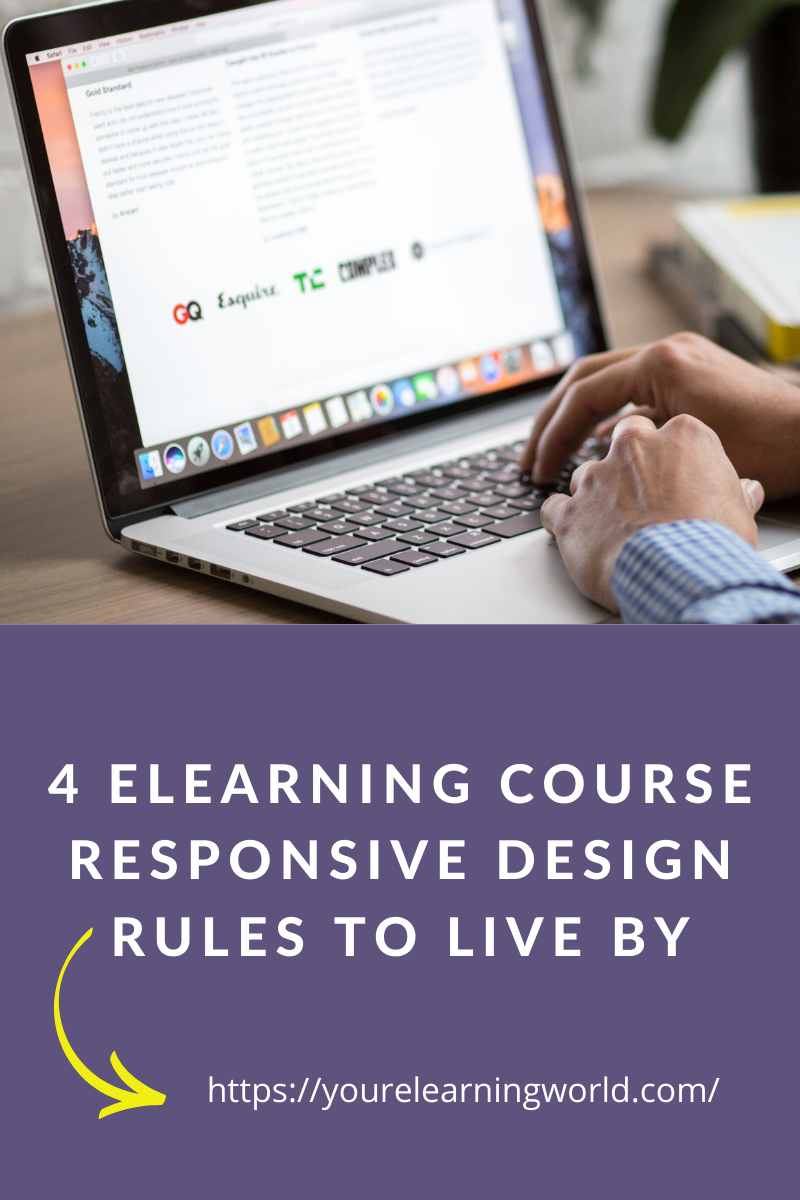
The days of learning only using a wide-format desktop screen are long gone. In fact, with the proliferation of devices with multiple screen sizes, it’s hard to know exactly which screens a course designer should use. So, what should Instructional Designers do? The answer is: Use responsive design techniques for the best results! The eLearning Challenge At Hand Responsive design addresses a real-life challenge that eLearning course designers and developers face. With portable devices and smartphones today, online learners can start a course on their 24-inch screen desktop at home, continue it on a 12-inch screen tablet during lunch, and finish a module on a 6-inch smartphone during their evening commute. Then, as they relax at home, they can review and revise key learning points on their 60-inch Smart TV. And if that’s not enough, they could even take a pop quiz using their 2-inch smartwatch screen! The challenge with these scenarios is that conventional course design principles just … [Read more...] about 4 eLearning Course Responsive Design Rules To Live By