

Instructional design produces the best results when we follow a methodical process. Unfortunately, whether you are a fan of Merrill’s Principles or Bloom’s Taxonomy, or whether you are an ADDIE devotee – there’s so much involved that it’s hard to keep track of what’s what. Having a set of handy cheat sheets, to gently remind you what needs to be done, can be an excellent way to ensure you dot all the I’s and cross all the T’s. Not only will cheat sheets help make your ID process as thorough and complete as possible, but it will also help you save time. Here are 6 cheat sheets that instructional designers will find useful. Cheat Sheet for Merrill's Principles of Instruction Merrill’s design theory, First Principles of Instruction, is a concise ID model that many novice and expert instructional designers might find extremely helpful. Here’s the Coles Notes version of what it entails: Use real-life problems in your instructional events Activate … [Read more...] about The ultimate instructional design models cheat sheet
Instructional Design and ELearning
How to Apply Bloom’s Taxonomy to Your ELearning Courses in 10 Easy Ways

Bloom’s Taxonomy was created in 1956 as a set of six cognitive skill categories. These ranged from lower-order abilities that require less cognitive processing skills, to skills of a higher-order that must demonstrate greater degrees of cognitive processing. In 2001, the original framework created by Benjamin Bloom was modified slightly, giving birth to the Revised Bloom’s Taxonomy (RBT). While the revisions do make it easier to understand and implement, the fundamental principles of BT remain unchanged. As a designer of eLearning courses, you can leverage the Revised Bloom’s Taxonomy to create powerful learning content. Let’s look at 10 simple ways in which you can do that. Real-world application Even though Bloom's Taxonomy (BT) was initially created for a classroom environment, its application is still very relevant to eLearning domains. That’s because the underlying cognitive principles enshrined within RBT are applicable to any form of learning. RBT has … [Read more...] about How to Apply Bloom’s Taxonomy to Your ELearning Courses in 10 Easy Ways
How to Tell If You Need to Start Looking for a New ELearning Authoring Tool
Many eLearning content developers have grown into their current state through evolution. You initially started by using stand-alone tools, such as Microsoft PowerPoint or other slide presentation tools to create your training courses. Then, you may have acquired other “add-on” tools and apps to enhance your authoring capabilities. At some point, the law of diminishing returns takes over: The more tools you add on, the less productive your team gets! Sadly though, sometimes it’s hard to notice that your existing eLearning authoring tools aren’t working for you. Signs that tell you that new tools are overdue You and your team have been using your existing eLearning authoring tools for several years now. Your team might feel very comfortable with the features and functionality they provide. And, because many of your authors and developers have become “experts” in using those tools, there might be a general feeling that there’s no need to change. And there lies the … [Read more...] about How to Tell If You Need to Start Looking for a New ELearning Authoring Tool
What Are The Best Authoring Tools for Developing Interactive ELearning Courses?

There’s no doubt that the future of learning is in eLearning. According to research, the market size has crossed $250 billion in 2020 and is expected to reach around $1 Trillion by 2027. The right tools Sure, you could probably pull off an eLearning course using Microsoft PowerPoint or Google Sides. You could use powerful imagery and create riveting handouts and course notes to supplement your slides. But will that be enough? Probably not! To really produce highly engaging, interactive eLearning content, you need some great course authoring tools to support you. Why? The “manual effort” involved in creating interactivity and spontaneity in eLearning content isn’t worth it! A tool makes it much easier to do that Most tools include huge libraries and archives of powerful supporting content, like icons, graphics, videos and images, that bring life to eLearning courses. Using stock images and icons in your courses is unprofessional, and doesn’t leave learners with a … [Read more...] about What Are The Best Authoring Tools for Developing Interactive ELearning Courses?
5 Easy Ways to Curate Your ELearning Content: Understanding what content curation is, and why it’s needed
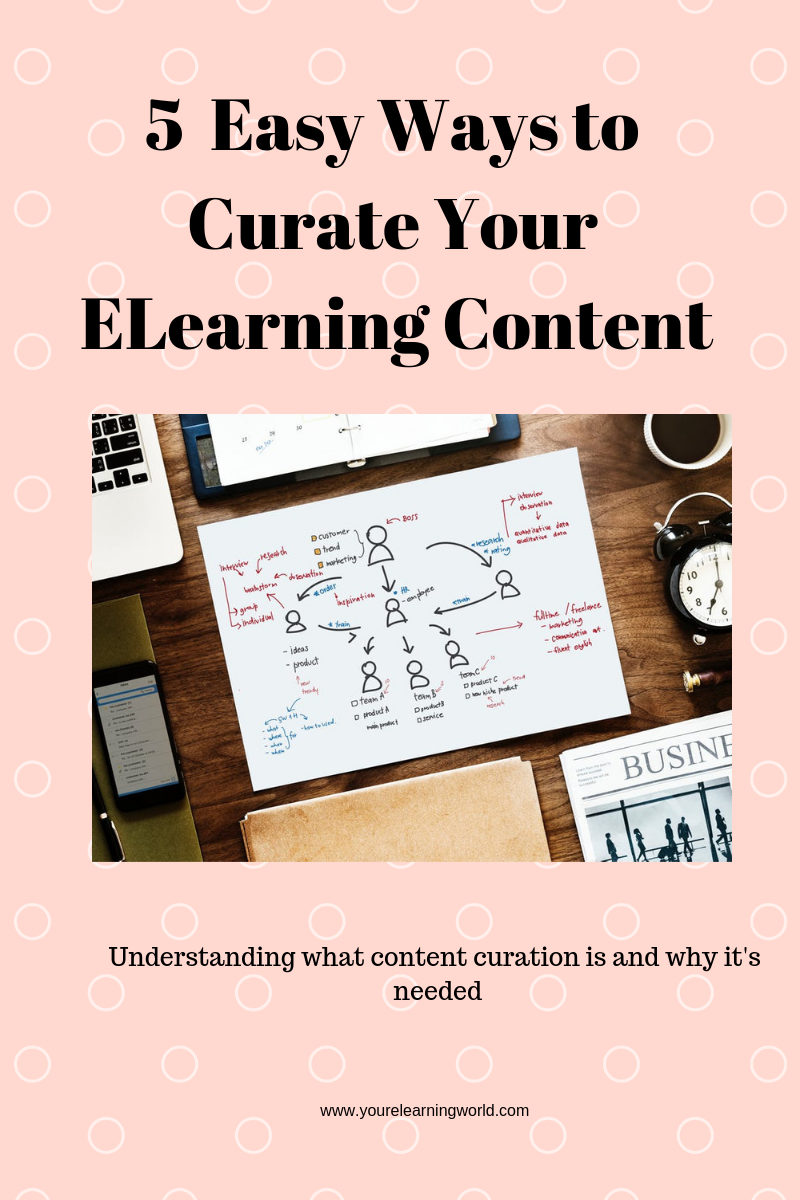
Everyday, millions of pieces of content get created online. So, if you were looking to “learn” more about a particular subject, is going through all those millions of bits of information really the best way to do so? That’s exactly the challenge that eLearning course designers and developers face. And more often than not, content curation is the best answer to this challenge. Assimilating eLearning content So, in the context of eLearning, what does it take to offer great content to your learners, and why should eLearners not go straight to the source – content creators – instead of reaching out for your curated content? Before we highlight why content curation is an essential part of eLearning, consider these facts about content creation first: According to Smithsonian Mag (a site owned/operated in partnership with the renowned Smithsonian Institution), there are over 1.8 million articles and research papers produced every year The same source cites that most of that … [Read more...] about 5 Easy Ways to Curate Your ELearning Content: Understanding what content curation is, and why it’s needed
8 Little Known Ways to Conduct Content Analysis for Your ELearning Course

When preparing to develop an eLearning course, or poised to deliver eLearning content, it’s always wise to conduct a thorough content analysis. While Needs Analysis will steer you on the right path to understanding the challenges faced by learners, it is Content Analysis that’ll offer the building blocks to successfully address those needs. Content Analysis 101 Academics define content analysis this way: “Content analysis is a research technique used to make replicable and valid inferences by interpreting and coding textual material” So, for the purposes of eLearning, what exactly is Content Analysis, and why should it matter when developing eLearning courses? Well, as humans, we are prone to “assuming” that what worked for us will also work for others. If we learned how to operate a piece of equipment (or perform a job function or use a software tool) using certain learning tools and content, or using a certain approach, we think others will learn using that same exact … [Read more...] about 8 Little Known Ways to Conduct Content Analysis for Your ELearning Course