

Having more content than you know what to do with is a common problem. It's actually more common than having too little, with course creators beginning the process with years of research, SME input, and ideas on what their mega-course will look like. Here are 5 things you can do if you have TOO MUCH content! #1 Keep focused on your learner What skills or knowledge are essential for their improvement? The content being added should always pass the "need to know vs. nice to know" test. If you're having trouble narrowing down what fits into each of these buckets, revisit the learning objectives and measure each chunk of content against that objective. Is it essential in helping the learner achieve the stated learning objective? If it's not, cut it from the course (but hold onto it and I'll tell you what to do with it later). #2 Deliver it like a bullet Just as you can have too many content ideas and topics, you can be too wordy on delivering them to your learner. Master the method … [Read more...] about How to Deal With Too Much Content and Avoid Information Overload
Instructional Design and ELearning
5 Tips For Effective ELearning Storyboards
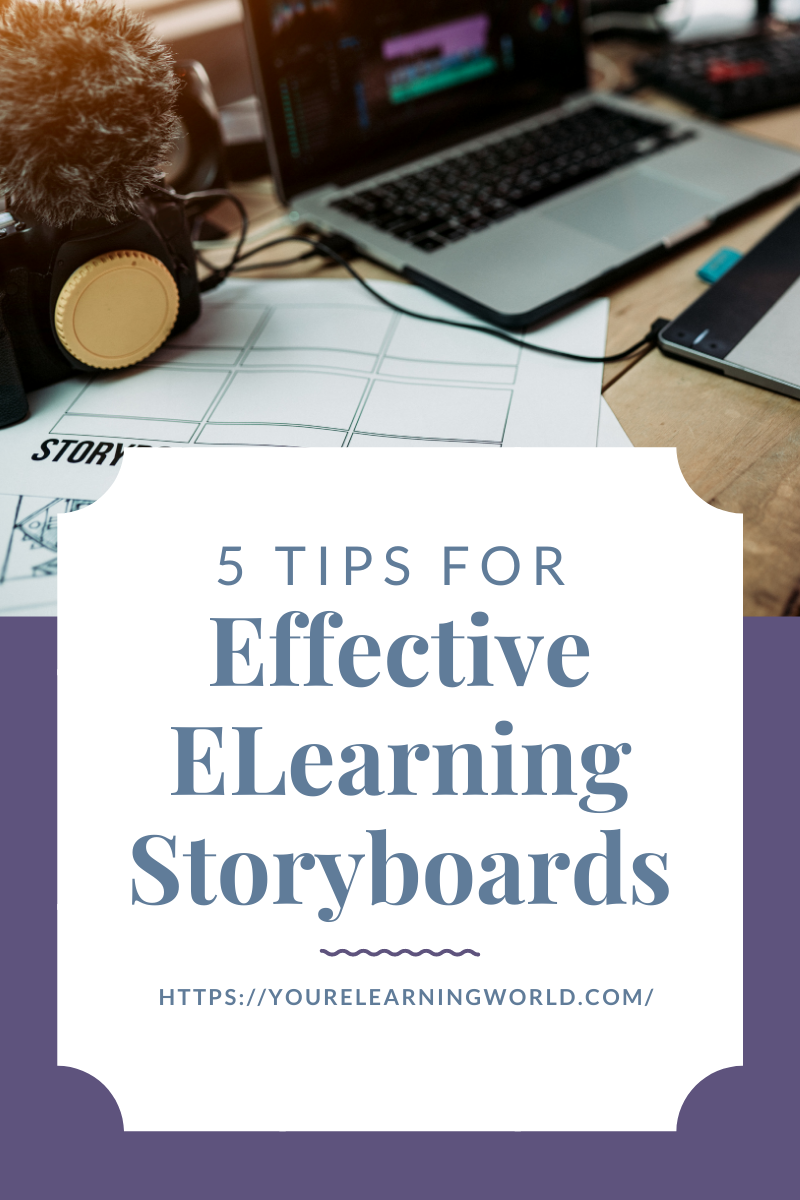
Storyboards are an essential element in designing your online course. They'll improve efficiency, save a lot of work/re-work down the road, and can also help communicate your ideas to stakeholders. Here 5 tips and best practices to get the most out of your storyboards! 1. Keep your goals in mind Why are you creating this eLearning course? Be clear on the purpose and content of your course, right from the start. If the course is truly your course, it should be much easier - you'll know the exact direction to head. However, if you're creating the course for a client, be sure everyone is on the same page (stakeholders, SMEs, course developers, etc.) I often find that what I think the course should be is drastically different from my client's expectations. 2. Don’t forget your audience Assuming you know your audience is a mistake. Research is key. This can come in the form of focus groups, surveys, or interviews to find out everything about the audience you're trying to … [Read more...] about 5 Tips For Effective ELearning Storyboards
Agile eLearning: Embracing Agile When Developing Elearning
Nimble organizations will win the day. Their ability to pivot quickly, and embrace favorable trends, technologies, and techniques make them more likely to triumph over their competitors. And it is that model that training-focused organizations must adapt in today’s remote work environment. Agile eLearning offers a solution. EMBRASING AGILE IN ELEARNING DEVELOPMENT Many organizations today employ dispersed workforces, working remotely – either independently or as part of a team. Developing eLearning courses in such environments is challenging. The “do more with less” mindset has led many businesses to rely on fixed-fee contractors and freelancers to supplement high-cost in-house expertise. Remote workforces rely on their employees being trained and ready with the knowledge and skills required to pivot quickly. However, given the backdrop of the realities of today’s virtual workforce, developing training programs that respond to the needs of nimble organizations is a … [Read more...] about Agile eLearning: Embracing Agile When Developing Elearning
Is Your Instructional Design From The ’90s?

Other than the technology used to deliver our online courses, some would argue that instructional design hasn’t changed much in the past several decades. We often see the same techniques used over and over in the courses we design and take. This isn’t a bad thing… as long as the techniques remain sound and relevant to our modern-day learners. The problem, however, is that it’s easy for our audience to get bored – they’ve already seen and done the techniques you’re using, often dozens of times. Instead of keeping that traditional mindset of instructional design, let’s consider a few ways to refresh our perspectives and design courses that are a bit more innovative, new, and unexpected! A design thinking mindset Learner Experience Design (LXD) focuses on design thinking. In other words, it looks at how to improve the entire end-user experience by considering how your instructional material is developed AND actually implemented. For example, as instructional designers, we know the … [Read more...] about Is Your Instructional Design From The ’90s?
How to Focus On “Backward Design” for Creating Online Courses

As course creators, we often design from the top down. We think we know exactly what our audience needs, and in turn, shape our course content around this framework. On the other hand, if we rely on "backward design" (where the content is learner-focused), our eLearning will achieve our objectives better and resonate with our audience. Here's how to stay focused on the learner and implement a backward design in eLearning. Ask the Right Question What do they need to know to be successful? A simple question, but let's break it down a bit. Note the qualifier "successful". This is extremely important. It's easy to be so close to your content that you lose sight of what your learner's goals actually are. I've taken many online courses that have completely failed at delivering the content needed to accomplish my goals. Instead, the designer created a course they wanted - not a course that the learner needed. To ensure you're meeting the need vs. the want, you have to look at things … [Read more...] about How to Focus On “Backward Design” for Creating Online Courses
5 Compelling Reasons To Implement The Interactive Design In Your Elearning Content
Interactive design certainly makes your online courses look sharp, but the bigger reason to use interactive design in eLearning is it boosts the quality of your learner’s experience – making your content engaging, yet easy. If you’re still not convinced. Here are 5 compelling reasons to implement the interactive design in all of your eLearning content! #1 Grab Their Attention The days of text-heavy, sleeper courses have come and gone. RIP dry PowerPoint slides. Enter videos, rich graphics, animations, photos, infographics, illustrations, and photos to grab your learner’s attention and bring the content to life. To grab your audience’s attention, the content must be more akin to the content they consume daily on social media and YouTube, not a boring mandatory corporate training lecture. #2 Hold Their Attention To prolong engagement, your eLearning must include the audience as an active participant in the learning journey. Bringing your content to life with immersive videos and … [Read more...] about 5 Compelling Reasons To Implement The Interactive Design In Your Elearning Content