
Instructional designers are always looking for new ways to create engaging and effective learning experiences for their learners. One of the tools that can help them achieve this goal is ChatGPT, a conversational AI system that can generate natural and coherent text on various topics. ChatGPT can help ID professionals design interactive and personalized learning activities that align with Bloom’s Taxonomy framework to target different levels of cognitive skills and learning objectives.
ChatGPT and Bloom’s Taxonomy: The Power Couple
Bloom’s Taxonomy is a widely used and recognized framework that categorizes learning objectives into three domains: cognitive, affective, and psychomotor. It helps educators and instructional designers (IDs) to design and assess learning activities that foster higher-order thinking skills. The original taxonomy, proposed by Bloom in 1956, had six levels: Knowledge, Comprehension, Application, Analysis, Synthesis, and Evaluation. The revised taxonomy, updated by Anderson and Krathwohl in 2001, replaced the nouns with verbs and swapped Synthesis and Evaluation, resulting in Remember, Understand, Apply, Analyze, Evaluate, and Create.
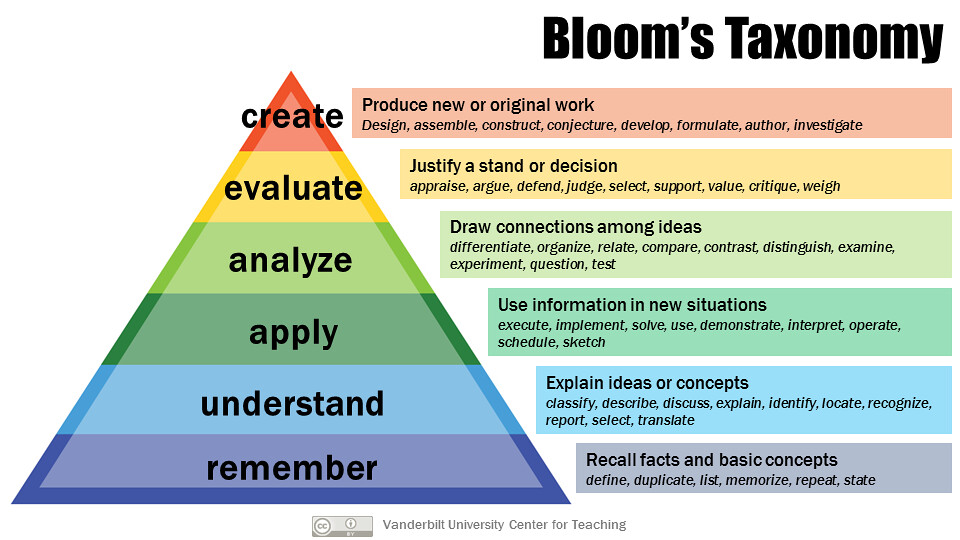
In the following discussions, we’ll explore how instructional designers can leverage ChatGPT to create engaging learning using Bloom’s Taxonomy framework. We will cover learning and teaching ideas from across all levels of the model, from remembering to creating. We will also provide real-world examples to highlight learning objectives, use cases, and activities for each level in the model.
1. Remember: Building Foundations
In the initial stages of learning, the foundation lies in recalling facts, concepts, and information. Leveraging ChatGPT, IDs can create interactive flashcards or quizzes that prompt learners to engage in recall activities. These activities serve as a bedrock, ensuring that learners have a solid grasp of the fundamental knowledge essential for higher-level cognitive processes.
For example:
- ChatGPT can generate flashcards or quizzes that test the learners’ recall of definitions, facts, dates, names, etc.
- It can generate summaries or outlines of a topic that highlight the main points and key information.
- It’s great at generating mnemonics or acronyms that help learners remember complex or abstract concepts.
Some examples of learning objectives at this level are:
- Identify the main components of the newly installed central HVAC system.
- List the steps of the scientific method.
- Recall the names and product details of the company’s main clients.
One real-world application of this concept is in corporate training scenarios. Here, IDs may lean into ChatGPT to simulate customer queries, prompting employees to recall product details and specifications. This not only reinforces foundational knowledge but also prepares them for practical applications in their roles.
Remembering, far from being a passive activity, becomes an interactive process when guided by ChatGPT. It sets the stage for subsequent levels of learning, laying the groundwork for a more comprehensive educational journey.
2. Understand: Making Connections
Moving beyond mere recall, the “Understand” level of Bloom’s Taxonomy encourages learners to make connections and comprehend information. ChatGPT can play a pivotal role in this phase by facilitating discussions and interactions with and between learners. Instructional Designers can craft case studies or scenarios where learners engage with ChatGPT to explain complex concepts in their own words, fostering a deeper understanding of the subject matter.
For example:
- It can generate questions or prompts that ask learners to explain, paraphrase, or illustrate a concept or idea in their own words.
- ChatGPT can also generate scenarios or examples that demonstrate how a concept or idea applies to real-world situations or problems.
- Use it to generate analogies or metaphors that help learners relate a concept or idea to something familiar or concrete.
Some examples of learning objectives at this level are:
- Explain the difference between renewable and non-renewable energy sources.
- Compare and contrast the features and functions of different medical devices.
- Summarize the main arguments and evidence of a persuasive essay.
In professional development, this could translate into using ChatGPT to initiate discussions on industry trends. Learners can immerse themselves in these trends, interpret data, and articulate their understanding. By incorporating ChatGPT into this process, the learning experience becomes not just informative but also participative and engaging.
Understanding, when guided by ChatGPT, becomes a collaborative journey. Learners not only comprehend information but actively participate in the process, creating a bridge between theoretical knowledge and practical application.
3. Apply: Bridging Theory and Practice
Application is a crucial aspect of learning, and ChatGPT can serve as a powerful tool to bridge the gap between theory and practice. By designing simulations or virtual scenarios, IDs can challenge learners to apply their knowledge in practical situations. ChatGPT can act as a guide, providing feedback and assistance as learners navigate through problem-solving exercises.
For example:
- ChatGPT can generate simulations or role-plays that require learners to use their knowledge and skills in realistic or hypothetical situations.
- It can generate problems or tasks that ask learners to apply their knowledge and skills to solve them or complete them.
- It’s used to generate feedback or hints that guide learners through the process of applying their knowledge and skills.
Some examples of learning objectives at this level are:
- Use a spreadsheet program to create a budget plan for a project.
- Apply the rules of grammar and punctuation to edit a paragraph.
- Solve an architectural problem involving measurements, dimensions, and other instrumental readings.
In technical training, for instance, IDs may use ChatGPT to help integrate troubleshooting simulations into their learning content. This allows learners to apply problem-solving skills in a controlled environment, preparing them for real-world challenges. The application phase, when enhanced by ChatGPT, becomes a more dynamic and hands-on experience.
4. Analyze: Breaking Down Information
Critical thinking is at the heart of the “Analyze” phase in Bloom’s Taxonomy. IDs may harness ChatGPT to encourage learners to critically examine information. Through guided discussions or debates facilitated by ChatGPT, learners can analyze different perspectives, question assumptions, and develop a deeper understanding of complex concepts.
For example:
- ChatGPT can generate diagrams or charts that help learners visualize and organize information into categories, hierarchies, sequences, etc.
- It can generate questions or prompts that ask learners to examine the relationships, causes, effects, assumptions, and biases of information.
- ChatGPT can generate criteria or rubrics that help learners evaluate the quality, validity, or relevance of information.
Some examples of learning objectives at this level are:
- Analyze the structure and elements of a poem.
- Identify the strengths and weaknesses of a business case or research study.
- Evaluate the credibility and reliability of different sources of information.
In leadership training, for example, ChatGPT can present case studies that require careful analysis. Learners, guided by the prompts from ChatGPT, can dig deeper into the intricacies of decision-making processes, honing their analytical skills. The analysis phase, with ChatGPT as a facilitator, becomes an intellectually stimulating exercise.
5. Evaluate: Assessing and Judging
The ability to assess information and make judgments is a crucial skill in any learning journey. IDs might consider incorporating ChatGPT into peer review activities, where learners evaluate and provide constructive feedback on each other’s work. This not only enhances the evaluation process but also fosters a sense of responsibility and accountability.
For example:
- ChatGPT can generate scenarios or dilemmas that require learners to make decisions or judgments based on ethical, moral, social, or economic factors.
- It can generate arguments or perspectives that represent different viewpoints or positions on an issue or topic.
- IDs may use ChatGPT to generate questions or prompts that ask learners to justify their decisions or opinions with evidence and reasoning.
Some examples of learning objectives at this level are:
- Evaluate the pros and cons of different energy sources and recommend the best one for a given set of client needs.
- Judge the effectiveness and appropriateness of a communication strategy for a specific audience and purpose.
- Form an opinion on a controversial corporate policy issue and support it with facts and arguments.
In project management training, for instance, ChatGPT can simulate a project review. Learners, guided by prompts, can assess the success of a project, identify areas for improvement, and make informed judgments. The evaluation phase, when enriched by ChatGPT, becomes a collaborative and reflective process.
6. Create: Fostering Innovation
At the pinnacle of Bloom’s Taxonomy is the “Create” phase, which encourages learners to generate new ideas and products. ChatGPT can serve as a catalyst for innovation by tasking learners with brainstorming sessions and creative exercises. In collaborative writing activities, for example, ChatGPT can stimulate the creation of unique and imaginative content.
For example:
- It can generate ideas or suggestions that inspire learners to come up with their own original or novel ideas or solutions.
- ChatGPT can generate templates or frameworks that help learners structure and organize their ideas or solutions into a coherent and logical format.
- ChatGPT can generate examples or models that show learners how to present or showcase their ideas or solutions effectively and appealingly.
Some examples of learning objectives at this level are:
- Create a short story based on a given theme or genre.
- Design a prototype of a new product that meets a specific need or problem.
- Invent a new game or activity that teaches a specific concept or skill.
By integrating ChatGPT into the creative process, Instructional Designers empower learners to think outside the box and contribute to the generation of new ideas and solutions. The creation phase, guided by ChatGPT, becomes an inspiring and transformative experience.
Parting Thoughts
In the evolving landscape of instructional design, ChatGPT is a powerful ally. By aligning activities with the levels of Bloom’s Taxonomy, IDs can craft learning experiences that cater to diverse learning styles. From building foundational knowledge to fostering creativity, ChatGPT serves as a versatile tool in the hands of educators, empowering them to create engaging, dynamic, and effective learning modules.
As we continue to explore the synergy between technology and education, the integration of tools like ChatGPT into instructional design promises to revolutionize the learning experience for students and professionals alike.
Want to know how ChatGPT can help you create interactive lessons, assessments, & personalized feedback that boost engagement & results? Get our brand new guide at its introductory price of $14.97 before it goes up: https://yourelearningworld.thinkific.com/courses/mastering-chatgpt-a-comprehensive-guide-for-learning-and-development-professionals
Leave a Reply