
• Skip to primary navigation
  • Skip to main content
  • Skip to footer
Your eLearning World

Your eLearning World

  • ABOUT
  • BOOKS & COURSES
  • WORK WITH ME
  • PORTFOLIO
  • COURSE CREATOR SERVICES
  • BLOG
  • CONTACT

Gagne’s Nine Events of Instruction: How to create eLearning experiences that will blow your learners’ minds

by Marina Leave a Comment

  • LinkedIn
  • Facebook
  • Twitter

Gagne's Nine Events of Instruction

If you are an instructional designer, you’ve probably heard of Robert Gagne. Gagne was an American educational psychologist best known for his Conditions of Learning. 


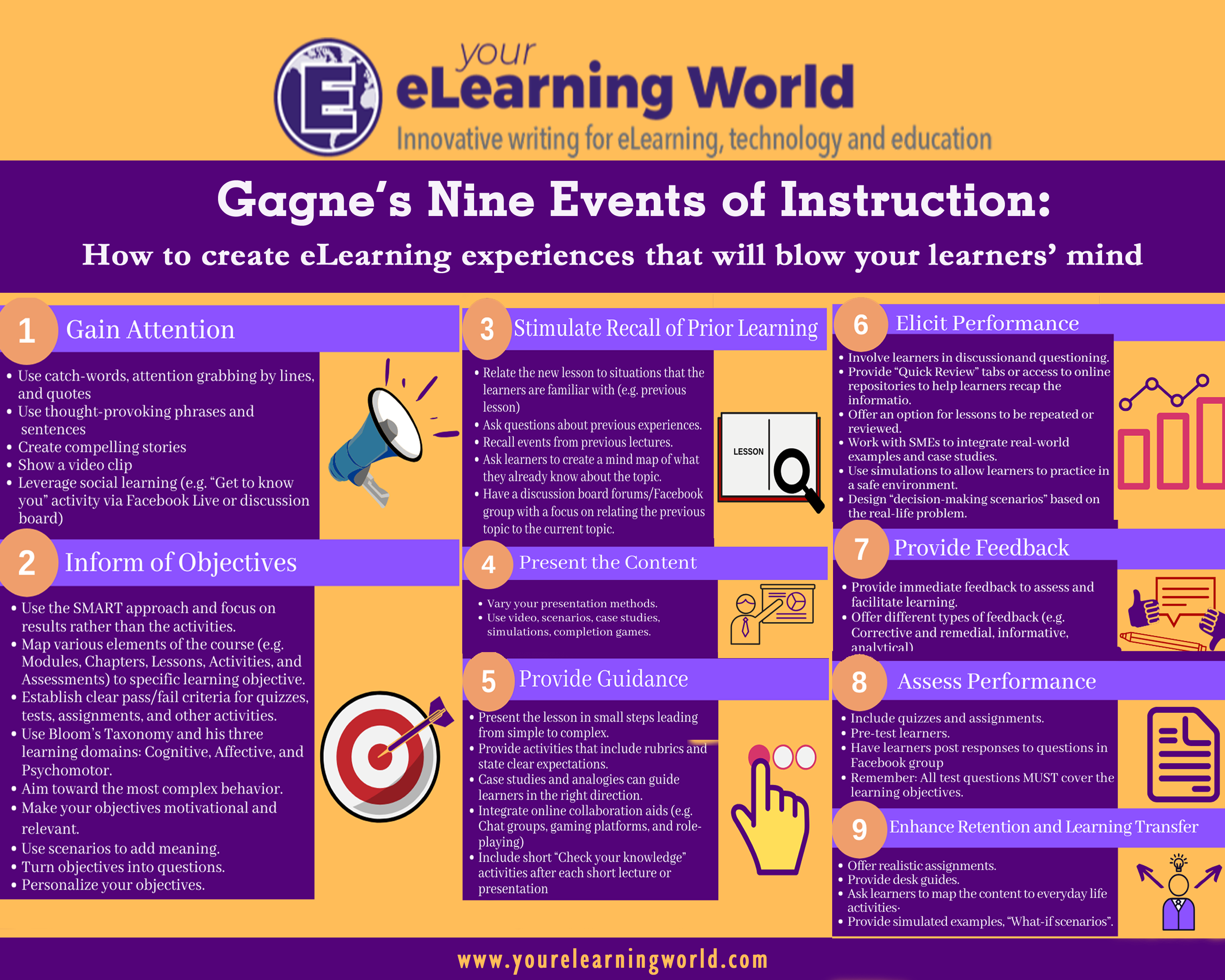
Gagne believed that there are several different levels of learning, and each level requires different types of instruction. He created a nine-step process that detailed each element required for effective learning:


The Nine-steps are: 

  1. Gain attention
  2. Inform learners of objectives
  3. Stimulate recall of prior learning
  4. Present the content
  5. Provide “learning guidance”
  6. Elicit performance (practice)
  7. Provide feedback
  8. Assess performance
  9. Enhance retention and transfer to the job


Gagne’s Nine Levels of Learning model provides a checklist that ensures that you present comprehensive and successful learning experience. His approach also motivates learners and helps them associate the topics covered in your course with their previous knowledge.  Another benefit of Gagne’s approach is that it allows for trial and error- learners are allowed to make mistakes and build on their past experiences. 


If you follow Gagne’s process, you’ll be able to create amazing eLearning courses even if you are new to instructional design. But, remember, instructional design is both a science and an art. It’s a science because it’s based on learning theories, and art because of the creative process involved in course design. Besides, all courses are different and there is no one size fits all, so to truly succeed as an instructional designer you need to understand the science behind the art.


When instructional designers hear of Gagne, they immediately think that his approach to course design does not apply to eLearning. Well, even though his original method was not created with eLearning in mind, it can easily be adapted to distance education. The infographic below shows you how.


Want more tips and tricks about creating truly successful eLearning courses? Sign up for our weekly newsletter here: https://yourelearningworld.com/newsletter/ 

Related Posts

  • Leveraging Gagné's Nine Events of Instruction
  • Synchronous ELearning: How To Engage Learners And Increase Retention
  • 6 Motivational Techniques for Adult Learners
  • LinkedIn
  • Facebook
  • Twitter

Filed Under: Instructional Design and ELearning Tagged With: creating effective lessons, designing motivational eLearning courses, Gagne's Nine Events of Instruction, how to design motivational eLearning, Robert Gagne

Reader Interactions

Leave a Reply Cancel reply

Your email address will not be published. Required fields are marked *

Footer

  • LinkedIn

Copyright © 2026 · Your eLearning World · Terms of Use · Privacy Policy

We use cookies to customize content and give you the best experience possible. If you continue to use
our site, we’ll assume that you’re happy with it!
AcceptReject Read More
Privacy & Cookies Policy

Privacy Overview

This website uses cookies to improve your experience while you navigate through the website. Out of these, the cookies that are categorized as necessary are stored on your browser as they are essential for the working of basic functionalities of the website. We also use third-party cookies that help us analyze and understand how you use this website. These cookies will be stored in your browser only with your consent. You also have the option to opt-out of these cookies. But opting out of some of these cookies may affect your browsing experience.
Necessary
Always Enabled
Necessary cookies are absolutely essential for the website to function properly. This category only includes cookies that ensures basic functionalities and security features of the website. These cookies do not store any personal information.
Non-necessary
Any cookies that may not be particularly necessary for the website to function and is used specifically to collect user personal data via analytics, ads, other embedded contents are termed as non-necessary cookies. It is mandatory to procure user consent prior to running these cookies on your website.
SAVE & ACCEPT