
Action Mapping is a popular instructional design method that helps you create engaging and relevant eLearning courses. It is based on the idea that learners need to perform specific actions to achieve their goals, rather than just acquire knowledge. By focusing on the actions and the outcomes, you can design eLearning solutions that are more effective and aligned with the business needs.
Here’s All You Need to Know
As an instructional designer, you are likely familiar with several L&D design methodologies and frameworks. These may range from traditional watershed design models, such as ADDIE (Analysis, Design, Development, Implementation, and Evaluation), to SAM (Successive Approximation Model), an agile model to jumpstart any L&D project. One highly effective tool in any IDs toolbox is Action Mapping – a technique for designing performance-based activities that align with business goals and learner needs.
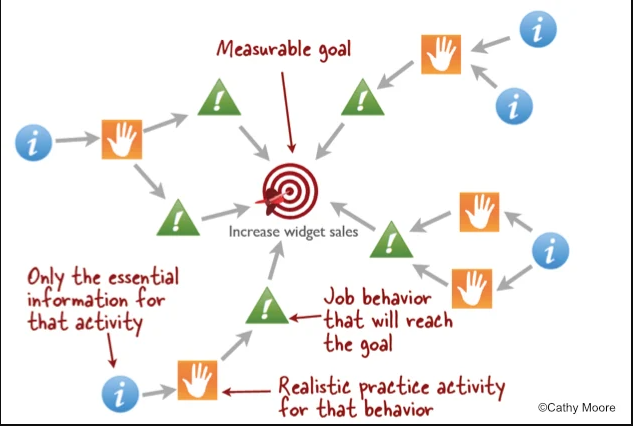
For learning designers to make the most of Action Maps, it helps to know the basics of Action Mapping, the steps and process involved, and when you should use it as an Instructional Designer. We’ll cover those aspects in some detail, and will also show you how Action Mapping works by using an example of creating an eLearning course for a real-world situation: training Healthcare workers on proper use of an MRI machine.
What is Action Mapping?
Action Mapping is a method developed by Cathy Moore, a renowned eLearning expert and author. It is a four-step process that helps you design eLearning courses that are action-oriented, learner-centered, and problem-based. This contrasts with other methodologies that are heavily focused on disseminating information.
The four steps of Action Mapping are:
- Identify the business goal: What is the problem that the business is looking to solve, or the opportunity that the organization plans to take advantage of? How will you measure success?
- Analyze the actions: What are the actions that learners need to take to achieve the goal? What are the core skills, and precise knowledge required for each action?
- Design the activities: What are the learning activities that will help learners practice and master the actions? How will you provide feedback and guidance?
- Provide the information: What are the information and resources that learners need to support their learning? How will you present them in clear and concise ways?
By following these steps, you can create eLearning courses that focus on performance improvement, rather than information delivery. You can also avoid unnecessary content that does not contribute to the goal or the actions.
When should you use Action Mapping?
Knowledge of an L&D tool, methodology, or process, doesn’t necessarily mean those frameworks are ideal for any given learning challenge. Action Mapping is a useful method for designing eLearning courses that target specific behaviors and outcomes. It is especially suitable for:
- Complex or high-stakes topics that require learners to apply critical thinking and problem-solving skills
- Scenarios or simulations that allow learners to practice realistic situations and receive feedback
- Performance support tools that provide learners with just-in-time information and guidance
- Blended learning solutions that combine online and offline activities
Learning situations that aren’t suitable for Action Mapping include:
- Basic or factual topics that require learners to memorize or recall information
- Quizzes or tests that assess learners’ knowledge or comprehension
- Informational or awareness-raising courses that do not have a clear business goal or action
Action maps are potent for detailing user-system interactions, best suited for sequential tasks like e-commerce account registration. They visually represent system scope in use case diagrams. However, for simple processes, opt for checklists; for dynamic tasks, consider agile user stories. Balance detailed flowcharts with higher-level use cases. Choose the technique wisely based on project needs and avoid unnecessary complexity.
How does Action Mapping work? An example
For L&D professionals new to Action Maps, initial contact with the process might seem overwhelming. However, once you understand the mechanics, at its core, it is a simple process. To illustrate how Action Mapping works, let’s look at an example of creating an eLearning course for training Healthcare workers on proper use of an MRI machine.
The Business Case: A hospital has acquired a new MRI machine to address a higher volume of patient requests for the service. The expectation was that, while improving service levels and delivering better patient outcomes, the new equipment would also contribute to increased revenue streams.
The L&D Challenge: Unfortunately, as healthcare providers used the MRI machine, they experienced a high number of instances where operators misused its features and capabilities. This resulted in failed tests, incorrect results, and repeating tests several times – an obvious waste of time and resources.
Taking Action: Hospital administrators concluded that the root cause is insufficient training on how to use the new machine. The L&D team, tasked with addressing that need, kicked off the project by pulling multiple stakeholders into several brainstorming sessions. At the end of those sessions, they came up with an action plan to design and develop targeted eLearning content to address the specific training needs.
ACTION MAPPING IN ACTION
Step 1: Identify the business goal
The business goal is to reduce the number of errors and accidents caused by improper use of the MRI machine. The success measure is to decrease the error rate by 50% in six months.
Step 2: Analyze the actions
The actions that learners need to take to achieve the goal are:
- Prepare the patient for the MRI scan
- Operate the MRI machine safely and correctly
- Interpret the MRI images accurately and diagnose any abnormalities
- Communicate effectively with other Healthcare professionals and patients
The skills and knowledge required for each action are:
- Medical terminology and anatomy related to MRI
- MRI safety procedures and guidelines
- MRI machine functions and settings
- MRI image analysis and interpretation
- Communication skills and etiquette
Step 3: Design the activities
The learning activities that will help learners practice and master the actions are:
- A pre-test to assess learners’ current level of knowledge and skills
- A scenario-based activity where learners must prepare a patient for an MRI scan, following a checklist of steps and answering questions along the way
- A simulation activity involving learners operating an MRI machine, adjusting the parameters and settings according to different cases and receiving feedback on their performance
- A case study activity where learners interpret an MRI image, identifying any abnormalities and writing a report with their findings and recommendations
- A role-play activity where learners communicate with a patient or another Healthcare professional, using appropriate language and tone
Step 4: Provide the information
The information and resources that learners need to support their learning are:
- A glossary of medical terms and acronyms related to MRI
- A video tutorial on how to use the MRI machine
- A reference guide on MRI safety procedures and guidelines
- A cheat sheet on MRI image analysis and interpretation
- A tip sheet on communication skills and etiquette
Trainers present this information, and related resources, in a minimalistic way, using bullet points, images, icons, charts, etc. They are also accessible on demand, rather than forced on learners. By using Action Mapping, we have created an eLearning course that is more effective in helping Healthcare workers use an MRI machine properly. We have also avoided unnecessary content that does not contribute to the goal or the actions.
Parting Words
Action Mapping is a powerful instructional design method that helps you create engaging and relevant eLearning courses. It is based on the idea that learners need to perform specific actions to achieve their goals, rather than just acquire knowledge. By following the four steps of Action Mapping, you can design eLearning solutions that are more aligned with the business needs and the learners’ needs.
Leave a Reply